- 最后登录
- 2009-8-29
- 在线时间
- 204 小时
- 寄托币
- 11554
- 声望
- 157
- 注册时间
- 2005-8-20
- 阅读权限
- 50
- 帖子
- 120
- 精华
- 7
- 积分
- 12860
- UID
- 2130513

- 声望
- 157
- 寄托币
- 11554
- 注册时间
- 2005-8-20
- 精华
- 7
- 帖子
- 120

|
 发表于 2007-9-13 00:21:23
|显示全部楼层
发表于 2007-9-13 00:21:23
|显示全部楼层
回复 #932 guesswhat 的帖子
I don't know...that is too far from in my major~~:o
Rosh HashanahFrom Wikipedia, the free encyclopedia
This article is about the Jewish holiday of Rosh Hashanah. For the tractate in the Talmud with the same name, see Rosh Hashanah (Talmud).
Rosh Hashanah (Hebrew: ראש השנה, Biblical: ˈɾoʃ haʃ:ɔˈnɔh, Israeli: ˈroʃ haʃaˈna, Yiddish: ˈroʊʃ hɑˈʃɔnə) is literally translated as "head of the year", and idiomatically refers to the Jewish New Year. The term first appears in the Tanakh, in Ezekiel 40:1.
In fact, Judaism has four "new year" observances which mark various legal "years", much like 1 January marks the "New Year" of the Gregorian calendar while other dates mark fiscal or other "new year" events. Rosh Hashanah is the new year for people, animals, and legal contracts. The Mishnah also sets this day aside as the new year for calculating calendar years and sabbatical (shemitta) and jubilee (yovel) years.
The Torah refers to the day as "The Day of the Blowing of the Shofar" (Yom Terua, Leviticus 23:24), and rabbinic literature and the liturgy itself describe Rosh Hashanah as "The Day of Judgment" (Yom ha-Din) and "The Day of Remembrance" (Yom ha-Zikkaron). Some midrashic descriptions depict God as sitting upon a throne, while books containing the deeds of all humanity are opened for review, and each person passing in front of Him for evaluation of his or her deeds. All of these names are also referenced in the holiday's exstensive liturgy.
This holiday is the first of the Yamim Noraim (Hebrew, "Days of Awe"), the most solemn days of the Jewish year; the Yamim Noraim are preceded by the month of Elul, during which Jews are supposed to begin a self-examination and repentance, a process that culminates in the ten days of the Yamim Noraim known as Asseret Yemei Teshuva - The Ten Days of Repentance, beginning with Rosh Hashanah and ending with the holiday of Yom Kippur.
[url=][/url]
[edit] DateRosh Hashanah extends over the first two days of the Hebrew month of Tishrei, even in Israel where most Jewish holidays last only one day. Since days in the Hebrew calendar begin at sundown, the beginning of Rosh Hashanah is at sundown the end of the 29th of Elul.
The second day is a later addition and does not follow from the literal reading of the Biblical commandment, which states that the holiday should be celebrated on the first day. The two days of Rosh Hashanah are considered "Yoma Arichtah" (Aramaic: "one long day"). There is some evidence that Rosh Hashanah was celebrated for only one day in Jerusalem as late as the thirteenth century. In Reconstructionist Judaism and Reform Judaism, some communities do indeed observe only the first day of Rosh Hashanah, while others observe two days. Orthodox and Conservative Judaism observe both the first and second days. The Karaite Jews who do not accept the "oral law" but rely only on Biblical scripture, observe only one day on the first day of Tishrei, since the second day is not mentioned in the Torah.
Rosh Hashanah occurs 163 days after the first day of Pesach (Passover). In the Gregorian calendar at present, Rosh Hashanah can occur September 5 at the earliest, as happened in 1899 and will happen again in 2013. After the year 2089, the differences between the Hebrew calendar and the Gregorian calendar will force Rosh Hashanah to be not earlier than September 6. Rosh Hashanah can occur October 5 at the latest, as happened in 1967 and will happen again in 2043. The Hebrew calendar is so constituted that the first day of Rosh Hashanah can never occur on the first, fourth, or sixth days of the Jewish week; the popular mnemonic is "lo be-adu rosh" ("Rosh [Hashanah] is not on adu"), where adu has the numerical value 1-4-6 (corresponding to the numbering of days in the Jewish week, in which Saturday night and Sunday daytime make up the first day).
The following table lists the two days of Jewish Rosh Hashanah for some years. Rosh Hashanah begins at sunset on the evening on the first day listed in the table.
Jewish New YearStarts (at sundown)Ends (at night)57672006-09-222006-09-2457682007-09-122007-09-1457692008-09-292008-10-0157702009-09-182009-09-2057712010-09-082010-09-10
[url=][/url]
[edit] Traditions and customs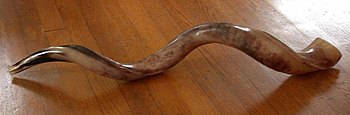 
A shofar in the Yemenite Jewish style. (Photo by Olve Utne (Olve)
This holiday is characterized by the blowing of the shofar (as per Leviticus 23:24), a trumpet made from a ram's horn. In fact, the shofar is blown in traditional communities every morning for the entire month of Elul, the month preceding Rosh Hashanah. The sound of the shofar is intended to awaken the listener from his or her "slumber" and alert them to the coming judgment (Maimonides, Yad, Laws of Repentance 3:4). Orthodox Judaism and some Conservative Judaic communities will not blow the shofar on Shabbat (There is an exception. Jewish Law permits the Shofar to be blown in the presence of a rabbinical court called the Sanhedrin, which had not existed since ancient times. A recent group of Orthodox rabbis in Israel claiming to constitute a modern Sanhedrin held, for the first time in many years, an Orthodox shofar-blowing on Shabbat for Rosh Hashana in 2006. [1])
In the period leading up to the Yamim Noraim ("Hebrew, "Days of Awe") penitential prayers, called selichot, are recited, and on Rosh Hashanah itself, religious poems, called piyyuttim, are added to the regular services. Special prayer books for Rosh Hashanah and Yom Kippur, called the mahzor (mahzorim pl), have developed over the years. Many poems refer to Psalms 81:3: "Blow the shofar on the [first day of the] month, when the [moon] is covered for our holiday".
Rosh Hashanah has a number of additions to the regular service, most notably an extended repetition of the Amidah prayer for both Shacharit and Mussaf. The Shofar is blown during Mussaf at several intervals. Biblical verses are recited at each point. According to the Mishnah, 10 verses (each) are said regarding kingship, remembrance, and the shofar itself, each accompanied by the blowing of the shofar. A variety of piyyutim, medieval penitential prayers, are recited regarding themes of repentance. The Alenu prayer is recited during the repetition of the Mussaf Amidah.
The traditional greeting on Rosh Hashanah is "Shana Tova" IPA [ʃaˈ na toˈ va], Hebrew for "A Good Year," or "Shana Tova Umetukah" for "A Good and Sweet Year." Because Jews are being judged by God for the coming year, a longer greeting translates as "May You Be Written and Sealed for a Good Year" (ketiva ve-chatima tovah).
During the afternoon of the first day occurs the practice of tashlikh, in which prayers are recited near natural flowing water, and one's sins are symbolically cast into the water. Many also have the custom to throw bread or pebbles into the water, to symbolize the "casting off" of sins. In some communities, if the first day of Rosh Hashanah occurs on Shabbat tashlikh is postponed to the second day. The traditional service for tashlikh is recited individually and includes the prayer "Who is like unto you, O God...And You will cast all their sins into the depths of the sea", and Biblical passages including Isaiah 11:9 ("They will not injure nor destroy in all My holy mountain, for the earth shall be as full of the knowledge of the Lord as the waters cover the sea") and Psalms 118:5-9, 121 and 130, as well as personal prayers.

Rosh Hashanah table set with symbolic foods.
Rosh Hashanah meals often include apples and honey, to symbolize a "sweet new year". Various other foods with a symbolic meaning may be served, depending on local minhag (custom), such as tongue or other meat from the head (to symbolise the "head" of the year). Other symbolic foods are dates, black-eyed beans, leek, spinach and gourd, all of which are mentioned in the Talmud. Pomegranates are used in many traditions: the use of apples and honey is a late medieval Ashkenazi addition, though it is now almost universally accepted. Typically, round challah bread is served, to symbolize the cycle of the year. On the second night, new fruits are served to warrant inclusion of the shehecheyanu blessing, the saying of which would otherwise be doubtful (as the second day is part of the "long day" mentioned above).
[edit] In the TorahIn the earliest times the Hebrew year began in autumn with the opening of the economic year. There followed in regular succession the seasons of seed-sowing, growth and ripening of the corn (here meaning any grain) under the influence of the former and the latter rains, harvest and ingathering of the fruits. In harmony with this was the order of the great agricultural festivals, according to the oldest legislation, namely, the feast of unleavened bread at the beginning of the barley harvest, in the month of Abib; the feast of harvest, seven weeks later; and the feast of ingathering at the going out or turn of the year (See Exodus 23:14-17; Deuteronomy 16:1-16).
It is likely that the new year was celebrated from ancient times in some special way. The earliest reference to such a custom is, probably, in the account of the vision of Ezekiel (Ezek. xl. 1). This took place at the beginning of the year, on the tenth day of the month (Tishri). On the same day the beginning of the year of jubilee was to be proclaimed by the blowing of trumpets (Lev. xxv. 9). According to the Septuagint rendering of Ezek. xlv. 20, special sacrifices were to be offered on the first day of the seventh month as well as on the first day of the first month. This first day of the seventh month was appointed by the Law to be "a day of blowing of trumpets". There was to be a holy convocation; no servile work was to be done; and special sacrifices were to be offered (Lev. xxiii. 23-25; Num. xxix. 1-6). This day was not expressly called New-Year's Day, but it was evidently so regarded by the Jews at a very early period.
[edit] In rabbinic literaturePhilo, in his treatise on the festivals, calls New-Year's Day the festival of the sacred moon and feast of the trumpets, and explains the blowing of the trumpets as being a memorial of the giving of the Torah and a reminder of God's benefits to mankind in general ("De Septennario," § 22).
The Mishnah, the core text of Judaism's oral Torah, contains the first known reference to the "Day of Judgment". It says: "Four times in the year the world is judged: On Passover a decree is passed on the produce of the soil; on Shavuot, on the fruits of the trees; on New-Year's Day all men pass before Him ("God"); and on the Feast of Tabernacles a decree is passed on the rain of the year.
R' Yaakov Kamenetsky explains that in earlier generations it was considered preferable not to reveal that it was a "day of judgement" so as not to mix any other feeling into "the day of the coronation of G-d". In later generations as people lost touch with the significance of the day it was necessary to reveal that it was also "the day of judgement" so that people would approach the holiday with proper awe and respect. (B'Mechitzot Rabbenu)
According to rabbinic tradition, the creation of the world was finished on Tishri 1.
The observance of the 1st of Tishri as Rosh ha-Shanah is based principally on the mention of "Zikkaron" (= "memorial day"; Lev. xxiii. 24) and the reference of Ezra to the day as one "holy to the Lord" (Neh. viii. 9) seem to point. The passage in Psalms (lxxxi. 5) referring to the solemn feast which is held on New Moon Day, when the shofar is sounded, as a day of "mishpat" (judgment) of "the God of Jacob" is taken to indicate the character of Rosh ha-Shanah.
In Jewish thought, Rosh ha-Shanah is the most important judgment-day, on which all the inhabitants of the world pass for judgment before the Creator, as sheep pass for examination before the shepherd. It is written in the Talmud, in the tractate on Rosh Hashanah that three books of account are opened on Rosh ha-Shanah, wherein the fate of the wicked, the righteous, and those of an intermediate class are recorded. The names of the righteous are immediately inscribed in the book of life, and they are sealed "to live." The middle class are allowed a respite of ten days till Yom Kippur, to repent and become righteous ; the wicked are "blotted out of the book of the living" (Ps. lxix. 28).
The zodiac sign of the balance for Tishri is claimed to indicate the scales of judgment, balancing the meritorious against the wicked acts of the person judged. The taking of an annual inventory of accounts on Rosh ha-Shanah is adduced by Rabbi Nahman ben Isaac from the passage in Deut. xi. 12, which says that the care of God is directed from "the beginning of the year even unto the end of the year". The 1st of Tishri was considered as the beginning of Creation.
It is said in the Talmud that on Rosh ha-Shanah the means of sustenance of every person are apportioned for the ensuing year; so also are his destined losses.
Originally, only the 1st day of Tishri was celebrated as New-Year's Day in the Land of Israel, prior to the time of Rabban Yohanan ben Zakkai. However, ever since his time, Jewish law has Rosh ha-Shanah celebrated for two days.
The Zohar, a medieval work of Kabbalah, lays stress on the universal observance of two days, and states that the two passages in Job (i. 6 and ii. 1), "when the sons of God came to present themselves before the Lord," refer to the first and second days of Rosh ha-Shanah, observed by the Heavenly Court before the Almighty. (Zohar, Pinchas, p. 231a)
[edit] See also[url=][/url]
[edit] References
[ 本帖最后由 zhangheng1020 于 2007-9-12 12:23 编辑 ] |
|





 GO
GO


 楼主: zhangheng1020


 Still here


 发表于 2007-9-19 11:43:20


 转发
转发


